Q2 2025 – Melbourne Retail Market
April 5th 2026 | , Urban Property Australia
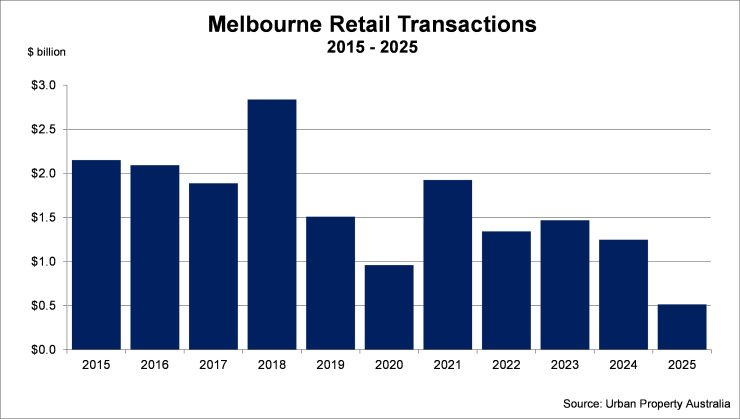
- More than $500 million transacted in the Melbourne retail property market over the first half of 2025 with the sales volume of 2025 on track to be the highest annual volume of retail property sales since 2021;
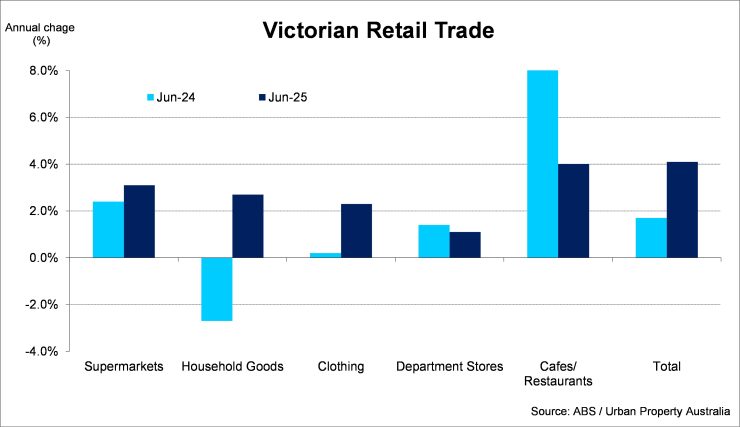
- Despite global uncertainties, retail sales remain relatively resilient, over the year to June 2025, retail trade increased by 4.1% in Victoria, significantly higher than the 1.7% growth recorded in June 2024;
- Rents generally remained stable across Victoria’s retail shopping centre assets over the year to June 2025 supported by limited new supply and ongoing population and employment growth.
Retail Market Summary
Despite global uncertainties, retail sales remain relatively resilient, boosted by solid population growth, stable employment and moderating inflation. Over the year to June 2025, retail trade increased by 4.1% in Victoria, significantly higher than the 1.7% growth recorded in June 2024. Retailer demand has been particularly strong in sectors with essential goods, such as supermarket-anchored neighbourhood centres. Limited new supply is intensifying leasing competition, particularly in prime locations. Both domestic and offshore purchasers are actively pursuing well-located, income-secure assets, with more than $500 million transacted in the Melbourne retail property market over the first half of 2025.
Sales Volume / Yields
Urban Property Australia research recorded more than $500 million transacted in the Melbourne retail property market over the first half of 2025. While transactional activity remains below the historical average, the sales volume of 2025 is on track to be the highest annual volume of retail property sales since 2021. This year’s volume of retail property sales has been boosted by the 50% share of the Northland shopping centre for $385 million, Victoria’s biggest retail transaction in seven years. Investment activity has been boosted by the 50 basis points in cash rate cuts during 2025, and further easing is expected to support ongoing investor interest. Both domestic and offshore purchasers are actively pursuing well-located, income-secure assets, particularly those with mixed-use or value-add potential. According to Urban Property Australia research retail yields remained largely stable across all asset types in the 12 months to June 2025, reflecting a market in balance amid improving investor sentiment and monetary easing.
Demand
Despite global uncertainties, retail sales remain relatively resilient, boosted by solid population growth, stable employment and moderating inflation. Over the year to June 2025, retail trade increased by 4.1% in Victoria, significantly higher than the 1.7% growth recorded in June 2024, although still well below its 10-year average of 5.0%. In comparison, Australian annual retail trade grew by 3.6% over the year to June 2025, also below its 10-year average.
Resilience in non-discretionary spending has buoyed the market, underpinned by easing inflation and stable labour market conditions. Retailer demand has been particularly strong in sectors with essential goods, such as supermarket-anchored neighbourhood centres and household goods in large format retail, the latter supported by ongoing housing activity. Limited new supply is intensifying leasing competition, particularly in prime locations with the CBD market is also experiencing a demand uplift as foot traffic recovers, driven by the return of employees to workplaces.
Similarly, increasingly more retail categories are also recovering with only a few recording contractions of retail sales over the year to June 2025. Interestingly, cosmetics outpaced all other categories, recording annual growth of 10.8% with trade still solid in cafes and restaurants with growth of 4.8%.Food retail sales grew at 3.1% over the year and accounts for 37% of all retail sales. Household goods (such as furniture and electrical goods) retail trade recorded growth of 2.7% over the year – boosted by mid-year sales.
Online retail trade in Australia continues to gradually take a larger share of overall spending. According to the ABS, as at June 2025, online sales made up 13% of total retail sales with Australian online sales with Australian consumers spending approximately $52.3 billion online over the past 12 months.
Rents generally remained stable across Victoria’s retail shopping centre assets over the year to June 2025 with large format centres and neighbourhood shopping centres outperforming other Victorian retail assets supported by limited new supply. Melbourne CBD retail rents are still experiencing downward pressure with tenant demand shallow. Rents are expected to gain momentum through the year as discretionary spending continues to recover.
Retail Strips
Total vacancy of Melbourne’s prime retail strips fell over the past 12 months with 9% of all shops vacant. The vacancy levels of Fitzroy Street, St Kilda is the highest at 15% with elevated vacancy rates at Chapel Street, South Yarra (9%) and Lygon Street, Carlton (11%). Elsewhere, the vacancy rate for Church Street, Brighton and High Street, Armadale remain very low with both strips recording vacancy rates lower than 3%.
The food and beverage sector continued to grow its presence across the strips, growing in the majority of the precincts however a number of fashion retailers have vacated the prominent strips, impacted by store rationalisation and the growing influence of e-commerce.
Several strips are benefiting from nearby developments, increasing the local population which have increased foot traffic to the precincts leading to increased tenant demand.
With many strips having been re-discovered by locals now working from home, some retailers have successfully adjusted to the changing consumer trends. With the workforce continuing to spend time working remotely, Urban Property Australia has witnessed increased demand from recreational tenants such as fitness and health businesses for locations in Melbourne’s prime strips as the local residents continue to change their spending patterns.
The elevated vacancy levels and rationalisation of some retailers has resulted in rental levels easing with some landlords also offering flexible lease terms and incentives to attract new occupiers. Now that more normalised spending patterns have emerged, looking forward, Urban Property Australia expect to see a broader range of tenants seeking exposure in the retail strips market.
Copyright © 2025 by Urban Property Australia All rights reserved. No part of this publication may be reproduced in any form, by microfilm, xerography, electronically or otherwise, or incorporated into any information retrieval system, without the written permission of the copyright owner.