Q4 2025 – Australian Economic Overview
April 5th 2026 | , Urban Property Australia
The Australian economy is gathering momentum in the face of substantial global headwinds, recording the fastest pace of growth in two years in the September 2025 quarter. Looking ahead, Australian economic growth is forecast to pick up to 2.25% in both 2026 and 2027.
Private investment has now contributed more to GDP growth than government investment for the past four consecutive quarters and it is forecast to remain the major driver of GDP growth. Growth in private final demand reflects robust growth in household disposable income, through a combination of real wages growth, employment growth, tax cuts, and lower interest rates. Spending on essentials is expected to remain robust over the next three years. Consumers, however, continue to be price sensitive and discount driven, particularly in relation to discretionary goods and services.
Along with increasing consumer spending, business investment has also risen, supported by investment in data centres, computer software and renewable energy. Lower borrowing costs, rising private demand and elevated capacity utilisation are expected to continue to support business investment going forward.
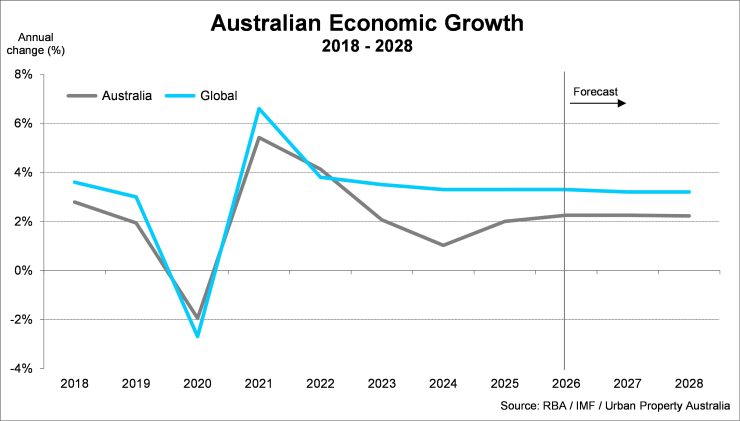
Growth in dwelling investment has also picked up and momentum is expected to be supported by lower financing costs. After rebounding in 2025, national home prices are forecast to rise further in 2026, in the order of 6–8%, with some capital cities (Brisbane, Perth) potentially seeing double digit gains. Australia’s chronic housing undersupply, coupled with strong population growth (through migration), is keeping upward pressure on house prices. Improved consumer confidence and government incentives for first-home buyers are providing additional support. Housing construction is also set to pick up in 2026. Building approvals and housing commencements have started rising again, which will translate into higher construction activity over the next 18 months. Large state programs for social housing and federal (like the Housing Australia Future Fund) will also support for affordable housing. These trends are supporting the expected pick-up in dwelling investment, with growth forecast to be 5.5% this year and 6% next year.
In contrast, public demand is expected to moderate as existing infrastructure projects are completed, and state governments commit to fewer new projects.
Inflation remains substantially below its peak in both headline and underlying terms. Recent increases in inflation can be partly attributed to temporary factors, such as the cessation of state electricity rebate schemes, large increases to council property rates and increases in volatile items such as fuel and travel. Inflation is expected to be 3.75% in mid-2026 and then moderate to 2.75% by mid-2027.
With underlying inflation outside the RBA’s target range, there is an increasing likelihood that the cash rate will be 3.85% by June and remain there for the rest of 2026 with a first rise of 25 basis points by March 2026.
The labour market is expected to remain resilient, with the unemployment rate expected to remain low by historic standards, at around 4.5% over the next two years. Employment growth is forecast to grow by 1.25% in 2026 and 1.5% 2027, with growth increasingly driven by the private sector. Nominal wages growth is expected to be 3.25% in coming years, which is well above the five-year pre-pandemic average.
Copyright © 2026 by Urban Property Australia All rights reserved. No part of this publication may be reproduced in any form, by microfilm, xerography, electronically or otherwise, or incorporated into any information retrieval system, without the written permission of the copyright owner.