Q4 2025 – Melbourne Industrial Market
April 5th 2026 | , Urban Property Australia
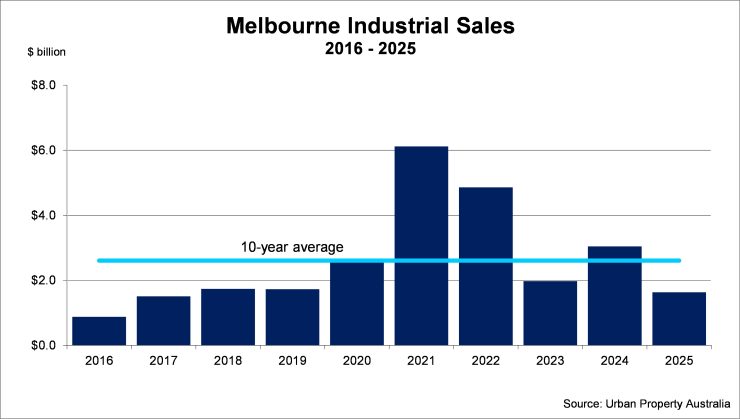
Sales activity in Melbourne’s industrial property market totalled $1.6 billion over 2025, its lowest annual level since 2019;
While leasing activity across the Melbourne industrial market was solid, the vacancy rate of Melbourne industrial market increased to 4.2% – its highest rate in five years;
Over 2025 close to 850,000 square metres of new industrial space was delivered to the Melbourne industrial market, with the bulk of the new supply completed was located in the South Eastern region.
Industrial Market Summary
The vacancy rate of Melbourne industrial market increased to 4.2% – its highest rate in five years. Vacancy rose in all regions, with the greatest annual increase recorded in the West. Sales activity in Melbourne’s industrial property market totalled $1.6 billion over 2025, its lowest annual level since 2019. Investment activity in Melbourne’s industrial property continues to be restrained because of the increase of the foreign owners’ land tax as witnessed by 46% decline in sales volume from the previous year and 37% lower than the 10-year average.
Sales Volume / Yields
Sales activity in Melbourne’s industrial property market totalled $1.6 billion over 2025 according to Urban Property Australia research, its lowest annual level since 2019. Investment activity in Melbourne’s industrial property continues to be restrained as a result of the increase of the foreign owners’ land tax as witnessed by 46% decline in sales volume from the previous year and 37% lower than the 10-year average. Sales volume has also been adversely affected by a lack of major sales with Urban Property research recording limited activity above $50 million. With limited transactions above $50 million recorded in 2025, the majority of Melbourne industrial properties sold in the past 12 months were acquired by private investors and owner occupiers. Investment volumes are expected to remain well below average annual levels with the state taxation policy affecting offshore investment. Melbourne yields are also being impacted by taxation policy, with the yield spread between Melbourne and Sydney and Brisbane industrial markets widening. Average Melbourne prime industrial yields have remained stable over the past year at 5.85% with average secondary yields sitting at 6.75% as at December 2025.
New Supply / Land Values
According to Urban Property Australia research, over 2025 close to 850,000 square metres of new industrial space was delivered to the Melbourne industrial market, just above the 10-year annual new supply average. The bulk of the new supply completed was located in the South Eastern region which was boosted by speculative developments followed by the Northern precinct and Western precinct. Looking ahead, new supply is projected to decline sharply this year with the pipeline of speculative development halving and Urban Property Australia research forecasting the lowest level of new industrial completions for the Melbourne market for 10 years. Industrial land values in Melbourne key industrial markets remained steady over 2025 with a slight pick up recorded in the final quarter of the year. Elevated debt costs have led to increased caution among developers and institutions with owner occupiers becoming more active. While Urban Property predicts that values have plateaued, land values are projected to remain relatively steady in coming years underpinned the constrained limited serviced lot availability offsetting challenging feasibility environment.
Tenant Demand
Despite the broader economic headwinds, according to Urban Property research, Melbourne industrial leasing activity surpassed 1.2 million square metres in 2025, an improvement of 23% compared to the previous 12 months and higher than the long-term average. Take-up activity was led by the Western region which accounted for 52% of total gross leasing activity followed by South East and North dominated by prime accommodation with tenants seeking modern properties. Logistics and retail trade occupiers, which have been boosted continued growth of e-commerce accounted for 55% of total Melbourne industrial leasing activity in 2025 followed by manufacturing. Looking ahead, tenant demand is projected to ease, albeit back to the long-term average, driven by the logistics and retail trade sectors as consumer spending levels continue to gather momentum. Occupiers are expected to remain focused on modern quality facilities given available options.
Vacancy / Rents
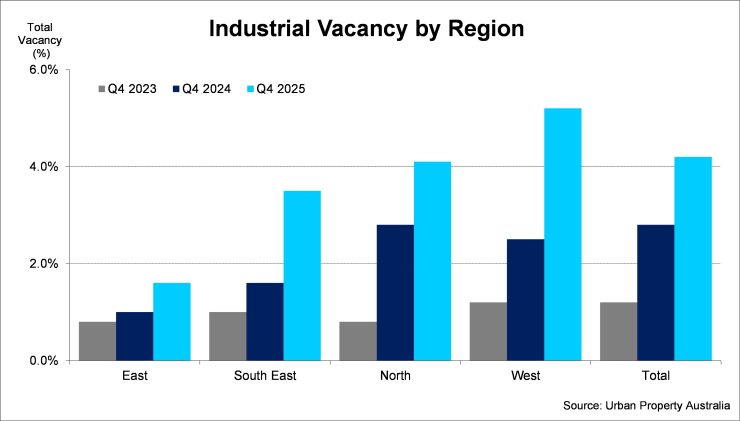
While leasing activity across the Melbourne industrial market was solid, it was surpassed by new supply which has led to another increase to the vacancy rate of the Melbourne industrial market. According to Urban Property Australia research, the vacancy rate of Melbourne industrial market increased to 4.2% – its highest rate in five years. Vacancy rose in all regions, with the greatest annual increase recorded in the West. Urban Property Australia research estimates that the industrial vacancy rate in the South East was 3.5% in January 2026, which as affected by a surge of speculative development. The industrial vacancy rate of the West at 5.2% was the highest of Melbourne’s industrial precincts, with the vacancy rate of the North rising to 4.1%.
Despite relatively solid leasing activity, the rising vacancy rate continues to moderate rental growth in the Melbourne industrial market. Over the 12 months to January 2026, according to Urban Property Australia research Melbourne prime industrial rents grew by 4% with secondary rents remaining steady. Incentive levels remain elevated as landlords competitively seek to attract occupiers in the high vacancy rate environment. Urban Property Australia expects that incentive levels have peaked as supply moderates in coming years and speculative development diminishes.
Copyright © 2026 by Urban Property Australia All rights reserved. No part of this publication may be reproduced in any form, by microfilm, xerography, electronically or otherwise, or incorporated into any information retrieval system, without the written permission of the copyright owner.