Q2 2025 – Australian Economic Overview
April 5th 2026 | , Urban Property Australia
The outlook for the economy is a little weaker amid heightened uncertainty. Although there have not been signs of a material deterioration in leading indicators, the pick-up in the Australian economy is expected to occur more gradually than previously forecast due to softer global demand and weaker consumption momentum. The effects of weaker demand are somewhat offset by the lower expected path for the cash rate. Australia’s economy is projected to grow by 2.1% this year, before growth of 2.2% forecast in both 2026 and 2027.
Household spending continued to grow in early 2025, though by a little less than expected prior to the introduction of US tariffs. While growth of household spending was broadly based, with increases recorded across discretionary and essential spending categories, it appears though consumers are concentrating their spending in promotional periods.
Housing market conditions have been stable in recent months after easing over most of 2024. New dwelling construction has remained steady in the year to date with weak commencements and capacity constraints in the finishing stages of the construction process continue to hold back activity. Building approvals for higher density construction have picked up however higher costs challenge the feasibility of some higher density construction. Housing price growth has been steady at a relatively low rate with the reduction in the cash rate in February yet to have a noticeable impact.
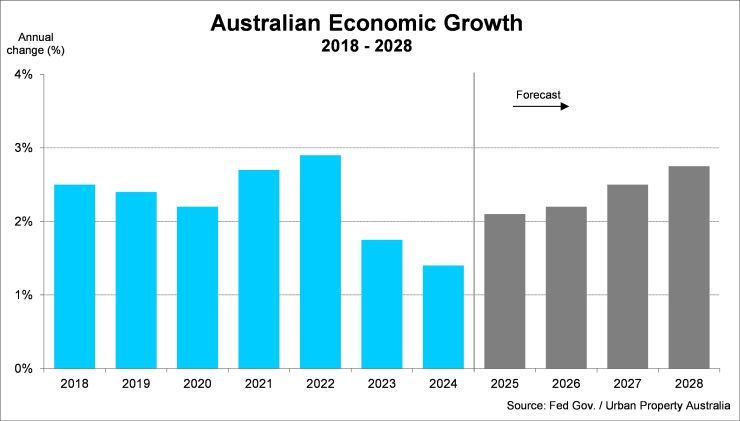
Total investment activity, increased by 2.9% over the past 12 months, driven by private investment which increased by 2.3%. While government investment rose by 5.1% over the year, its annual rate has fallen from 6.8% six months earlier. Looking ahead, the transition from public-sector-led growth to private-sector-driven activity will take time. However, with further rate cuts expected, it is anticipated that private sector momentum will gradually build.
Employment market conditions are expected to ease a little over the next 12 months with the unemployment rate is expected given the softer outlook for economic growth this year. The unemployment rate is forecast to increase to 4.3% over 2025 and is then expected to stabilise in early 2026 as GDP growth picks up further.
Over the past year the easing in inflation has proceeded broadly as expected, or a little quicker. The consumer price index of 2.7% over the year to 30 June 2025, down from an annual rate of 2.9% in the March quarter suggests that interest rates will be reduced further. Looking ahead, inflation is now expected to be in the RBA range for the next three years.
With inflation seemingly within the target band, most commentators are now predicting that the RBA will cut the cash rate by 25 basis points in August with the market pricing in two to three rate cuts by the RBA between June and the end of 2025, on top of cash rate reductions in February and May this year.
Australian population growth continues to ease with net overseas migration declining from its peak in mid-2023 reflecting lower migrant arrivals. Net overseas migration levels are projected to ease over the next year before stabilising from mid-2026.
Copyright © 2025 by Urban Property Australia All rights reserved. No part of this publication may be reproduced in any form, by microfilm, xerography, electronically or otherwise, or incorporated into any information retrieval system, without the written permission of the copyright owner.