Q1 2026– Melbourne Retail Market
April 30th 2026 | , Urban Property Australia
- Victorian household spending increased by 3.8%, its growth rate softening in line with higher cost of living pressures with discretionary spending contracting over the year;
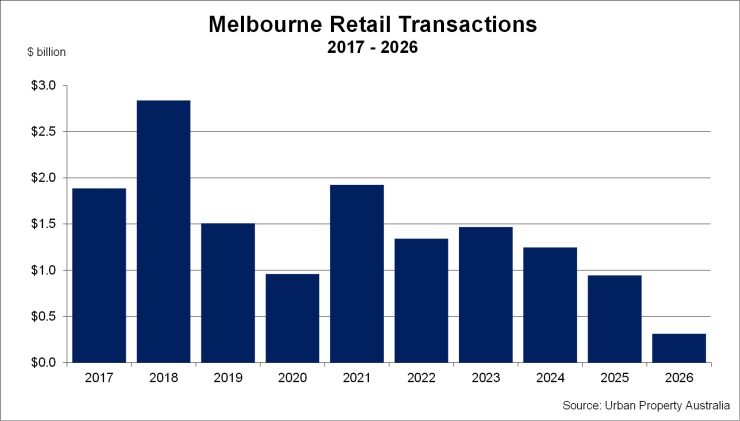
- Around $300 million was transacted in the Melbourne retail property market over the first quarter of 2026, lower than levels achieved in the past two years;
- Rental levels across all asset types have largely remained steady apart from the prime CBD properties, which continue to realign to the new working patterns and night-time economy.
Retail Market Summary
Over the year to February 2026, Victorian household spending increased by 3.8%, its growth rate softening in line with higher cost of living pressures. Adversely impacted by the higher cost of living, discretionary spending contracted by 2.8% over the year to February 2026 whereas non-discretionary Victorian household spending increased by 0.8% over the year. While transactional activity remains below the historical average, investors’ appetite remains robust for retail property with consumer spending somewhat surprisingly remaining relatively resilient for the past two years with $300 million transacted in the Melbourne retail property market over the first quarter of 2026.
Sales Volume / Yields
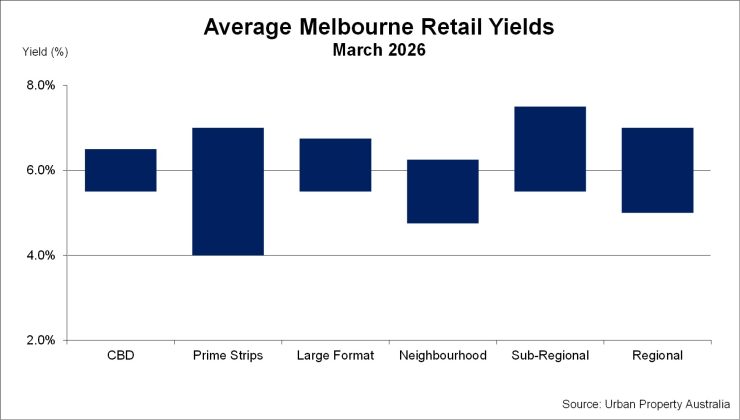
Urban Property Australia research recorded more than $300 million transacted in the Melbourne retail property market over the first quarter of 2026 – lower than levels achieved in the past two years. While transactional activity remains below the historical average, investors’ appetite remains robust for retail property with consumer spending somewhat surprisingly remaining relatively resilient for the past two years. Of the sales volume of retail property recorded in 2026 to date, more than half was accounted by the sale of two assets – Charter Hall’s acquisition of the Summerhill Shopping Centre for $91 million and the sale of Chadstone Lifestyle Centre for $86 million. Investors continue to concentrate on assets supported by higher non-discretionary retail trade exposure, established anchor tenants, and convenience-focused retailing. With limited opportunity to invest but increasing investor appetite from both private and institutions, shopping centre yields have largely remained steady over the year. Yields for prime CBD and retail strip assets are showing signs of increasing reflecting the elevated vacancy rates of both asset types and investor caution. Looking ahead, Urban Property expects that yields to continue to be under downward pressure reflecting the scarcity and seemingly resilience of high-quality retail assets.
Demand
Despite easing employment growth, nation-leading population growth continues to underpin Victorian household spending. Over the year to February 2026, Victorian household spending increased by 3.8%, its growth rate softening in line with higher cost of living pressures. Adversely impacted by the higher cost of living, discretionary spending contracted by 2.8% over the year to February 2026 whereas non-discretionary Victorian household spending increased by 0.8% over the year. While sales of alcohol and tobacco have contracted, clothing retail sales increased by 5.1% over the year with growth also recorded in household goods (+3.7%), food (+5.2%) and cafes and restaurants (+4.8%).
Retailer demand remains subdued for most discretionary forms of retail, with national retailers focusing on optimal locations rather than volume in expansion strategies. Non-traditional forms of retail services, including healthcare, wellness and gyms, have driven leasing activity.
Urban Property research recorded largely steady rental levels across all asset types apart from the prime CBD properties, which continues to realign to the new working patterns and night-time economy. Over the 12 months to March 2026, neighbourhood shopping centres continued to outperform other Victorian retail assets with growth also recorded in sub-regional shopping centres. Looking forward, Urban Property research anticipates that rents will continue to increase, albeit modestly in 2026 with consumers increasingly cautious as a result of the Middle East conflict. Rents for CBD-based assets are likely to continue to face downward pressure, hindered by lower visitation trends and changing worker and consumer trends compared to pre-2020.
Retail Strips
Total vacancy of Melbourne’s prime retail strips increased over the past 12 months with 12% of all shops vacant. The vacancy levels of Bridge Road, Richmond remains the highest at 18% with elevated vacancy rates at Chapel Street, South Yarra (14%) and Lygon Street, Carlton (11%). Elsewhere, the vacancy rate for Church Street, Brighton and Puckle Street, Moonee Ponds remain very low with both strips recording vacancy rates lower than 3%.
Melbourne’s prime strips performance varies significantly with levels of vacancy and neighbourhood amenities. The food and beverage sector continued to grow its presence across the strips, growing in the majority of the precincts however a number of fashion retailers have vacated the prominent strips, impacted by store rationalisation and the growing influence of e-commerce. Increasingly, the tenancy mixes are becoming more diverse with service-based businesses such as gyms, allied health and education expanding their presence in the strips.
Several strips are benefiting from nearby developments, increasing the local population which have increased foot traffic to the precincts leading to increased tenant demand. The Victorian government’s activity centre program would likely further boost shopping strip foot traffic with the state government, encouraging more than 300,000 homes to be built close to public transport, jobs and services.
The continued elevated vacancy levels and rationalisation of some retailers have resulted in rental levels easing with Urban Property Australia seeing landlords also offering flexible lease terms and incentives to attract new occupiers.
Copyright © 2026 by Urban Property Australia All rights reserved. No part of this publication may be reproduced in any form, by microfilm, xerography, electronically or otherwise, or incorporated into any information retrieval system, without the written permission of the copyright owner.