Q2 2025 – Melbourne Industrial Market
April 5th 2026 | , Urban Property Australia
- As a result of the increase in tax for foreign owners, domestic investors have acquired the bulk of properties sold in 2025 with investment activity picking up in the second quarter of 2025;
- Impacted by the softening leasing activity of 2025, the vacancy rate of the Melbourne industrial market marginally increased over the second quarter of 2025, rising to 3.0%;
- New supply levels have moderated in the Melbourne industrial market as developers have adopted a pre-lease strategy amidst elevated construction costs and rising vacancies.
Industrial Market Summary
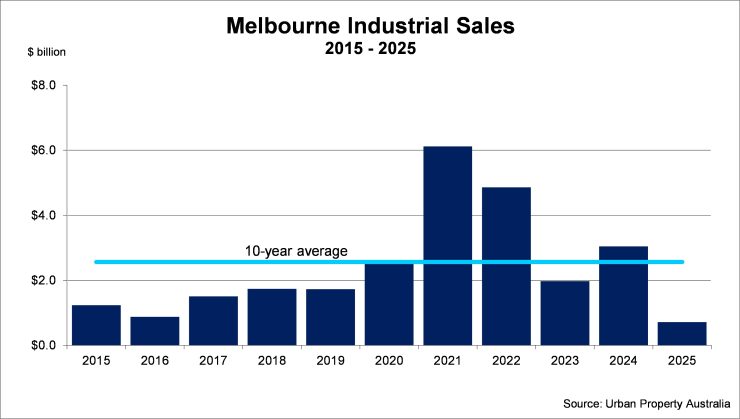
After a solid start to 2025, leasing activity in the Melbourne industrial market has softened in the second quarter of 2025. Leasing activity continues to be underpinned by logistics and retail trade occupiers who accounted for 64% of take up in 2025 to date. Despite broader economic headwinds, the fundamentals supporting tenant demand remain intact underpinned by population growth and e-commerce trends. Investment activity in the Melbourne industrial market picked up in the second quarter of 2025, with more than $700 million now transacted this year.
Sales Volume / Yields
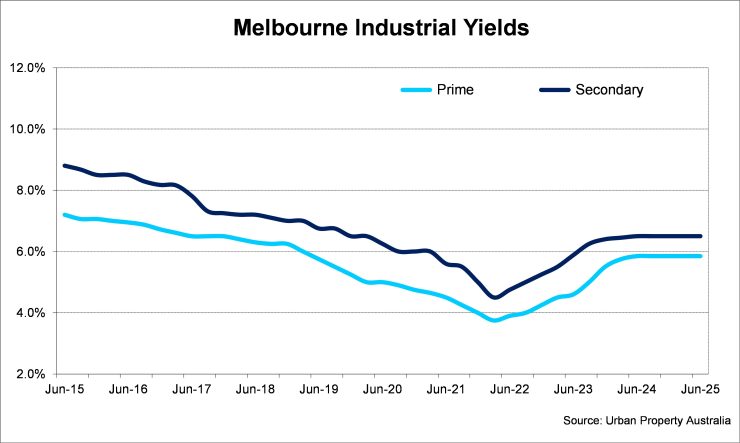
Investment activity in the Melbourne industrial market picked up in the second quarter of 2025, with investor sentiment buoyed by the two interest rate cuts, and expectations for further easing down. In 2025 to date, more than $700 million of industrial property has been transacted, largely driven by institutional purchasers. As a result of the increase in tax for foreign owners, domestic investors have acquired the bulk of properties sold in 2025. While transactional volume has increased through the year, Melbourne industrial yields have remained steady in the 12 months to June 2025. Urban Property research estimate that average prime industrial yields sit at 5.85% with average secondary yields sitting at 6.5% as at June 2025.
New Supply / Land Values
According to Urban Property Australia research, new industrial supply in the Melbourne industrial market is forecast to total 900,000 square metres this year, close to the amount of 950,000 square metres delivered last year. New supply levels have moderated in the Melbourne industrial market as developers have adopted a pre-lease strategy amidst elevated construction costs and rising vacancies with relatively limited speculative development currently under construction. The bulk of the new supply scheduled for completion this year is located in the South Eastern region accounting for 40% of new supply currently under construction in the Melbourne industrial market. Of the stock scheduled for completion in 2025, the level of pre-committed stock has risen through the year as the speculative development pipeline contracts. Industrial land values in Melbourne key industrial markets have remained stable through the 12 months to June 2025 despite easing momentum. As developers adopt a more cautious pipeline approach, land banking activity remains selective. Over the second half of 2025, Urban Property predicts that values are expected to remain stable, and unlikely to experience strong growth without a significant reduction in construction costs.
Tenant Demand
After a solid start to 2025, leasing activity in the Melbourne industrial market has softened in the second quarter of 2025. Leasing activity continues to be underpinned by logistics and retail trade occupiers who accounted for 64% of take up in 2025 to date. Despite broader economic headwinds, the fundamentals supporting tenant demand remain intact underpinned by population growth, e-commerce trends, and infrastructure investment. Owner-occupier interest also contributed meaningfully to take-up. Looking ahead, while tenant demand has softened compared to recent years, current levels continue to exceed long-term averages, supported by improving sentiment due to interest rate cuts and reduced inflation.
Vacancy / Rents
Impacted by the softening leasing activity of 2025, the vacancy rate of the Melbourne industrial market marginally increased over the second quarter of 2025, rising to 3.0%, according to Urban Property Australia research. In line with the leasing activity, vacancy fell in the South Eastern and Western regions whereas the North recorded an increase in industrial vacancy levels as at June 2025. Urban Property Australia research estimates that the industrial vacancy rate in the South East has declined to 1.4% as at June 2025 with industrial vacancy rate of the West at 2.2% and 4.7% in the North.
Prime Melbourne industrial rents have remained stable over the 12 months to June 2025, according to Urban Property Australia research whereas secondary industrial rents fell slightly. While rental increases have moderated, prime assets in core locations will continue to perform well, albeit in regions of tight vacancy. Incentive levels remain elevated as landlords competitively seek to secure quality occupiers and Urban Property Australia expects that incentive levels will continue to remain relatively high with the shallow tenant demand environment.
Copyright © 2025 by Urban Property Australia All rights reserved. No part of this publication may be reproduced in any form, by microfilm, xerography, electronically or otherwise, or incorporated into any information retrieval system, without the written permission of the copyright owner.