Q4 2025 – Global Economic Overview
April 5th 2026 | , Urban Property Australia
The global economy has shown notable resilience to heightened trade tensions and policy uncertainty with global growth projected to increase by 3.3% in 2026; The Australian economy is gathering momentum in the face of substantial global headwinds with growth forecast to pick up to 2.25% in both 2026 and 2027; The Victorian economy is forecast to increase by 2.50% over the 12 months to June 2026, up from 1.8% recorded over the preceding year.
Economic Summary
The global economy has shown notable resilience to heightened trade tensions and policy uncertainty; however, the global economic outlook remains clouded by elevated macroeconomic uncertainties and shifting trade policies. Risks to the outlook remain tilted to the downside, however global activity could be further lifted by AI-related investment. The Australian economy is gathering momentum in the face of substantial global headwinds, recording the fastest pace of growth in two years. Looking ahead, Australian economic growth is forecast to pick up to 2.25% in both 2026 and 2027.
Q4 2025 – Global Economic Overview
The global economy has shown notable resilience to heightened trade tensions and policy uncertainty; however, the global economic outlook remains clouded by elevated macroeconomic uncertainties, shifting trade policies, and persistent fiscal challenges.
Trade tensions have continued to abate but remain subject to occasional flare-ups such as a dispute between China and the United States involving controls on exports of semiconductors and rare earth minerals. Meanwhile, rapid advances in artificial intelligence and clean energy technologies, together with the expansion of digital infrastructure and growing demand for critical minerals, are spurring new waves of investment and innovation.
Global inflation continued to decline, with headline inflation easing to an estimated 3.4% through 2025 and is projected to slow further to 3.1% in 2026. The decline has been driven by lower energy and food prices, more stable exchange rates, and slower nominal wage growth. About 40% of the world’s countries saw inflation return to long-term averages in 2025, yet progress towards central bank targets remains slower than anticipated.
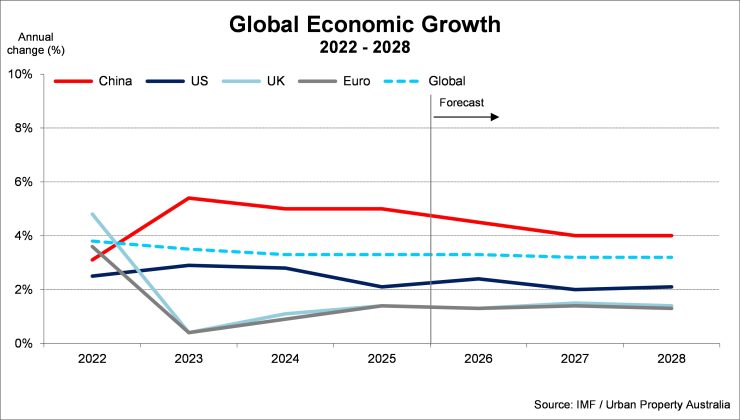
Continued macroeconomic policy support is expected to cushion the impact of higher tariffs, but growth in trade and overall activity are likely to moderate in the near term. Global growth is projected to increase by 3.3% in 2026 and 3.2% in 2027. Risks to the outlook remain tilted to the downside with potential trade tension flare ups prolonging uncertainty and weighing more heavily on activity. Whereas global activity could be further lifted by AI-related investment and eventually transform into sustainable growth if faster AI adoption translates into strong productivity gains and increased business dynamism.
In the United States, the economy is projected to expand by 2.4% in 2026, supported by fiscal policy and a lower policy rate, while the impact of higher trade barriers also gradually wanes. Growth is projected to remain solid at 2.0% in 2027, with a near-term fiscal boost from tax incentives for corporate investment under the One Big Beautiful Bill Act of 2025. Technology-driven momentum is expected to moderate but still provide some offset to lower immigration and moderating consumption.
In the Euro area, economic growth is expected to remain steady at 1.3% in 2026 and at 1.4% in 2027, reflecting projected increases in public spending, notably in Germany. Resilient consumer spending, supported by stable labour markets and rising real wages, remains the main driver of growth, while higher United States tariffs and geopolitical uncertainty will likely weigh on exports.
In the United Kingdom, its economy is projected to grow by 1.3% in 2026, in line with the growth of 1.3% of last year. Lower inflation and interest rates, combined with the fading impact of the large increase in employment taxes and the uncertainty from 2025, is expected to result in growth of 1.5% in 2027.
In China, domestic economic activity growth has softened, but net exports have continued to support GDP growth. The economy of China is projected to grow by 4.5% in 2026 and 4.0% in 2027 down from 4.9% expansion achieved in 2025. A temporary easing of trade tensions with the United States including targeted tariff reductions and a one-year trade truce has helped stabilise confidence, while policy support is expected to sustain domestic demand.
In India, growth is projected to moderate to 6.4% this year and in 2027 supported by resilient consumption and strong public investment, which should largely offset the adverse impact of higher United States tariffs but lower than the 7.3% growth recorded for 2025.
Copyright © 2026 by Urban Property Australia All rights reserved. No part of this publication may be reproduced in any form, by microfilm, xerography, electronically or otherwise, or incorporated into any information retrieval system, without the written permission of the copyright owner.