Q1 2026 – Australian Economic Overview
April 30th 2026 | , Urban Property Australia
Although the Iran conflict has clouded the outlook for the Australian economy, the pace of growth of the domestic economy has exceeded expectations, with annual growth having accelerated for the fifth consecutive quarter, reaching the fastest pace of growth since 2023. While the Australian economy is not immune to global developments but is well-positioned to outperform most of its developed economy peers.
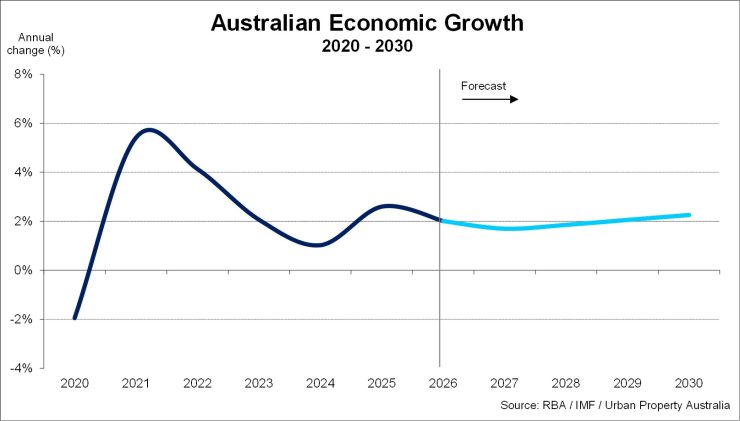
Looking ahead, Australian economic growth is forecast to record an increase of 2.0% this year with growth easing to 1.7% in 2027, both revised lower compared to pre-conflict projections. In terms of specific industries, conditions for the manufacturing industry remain difficult with elevated energy prices weigh on competitiveness, whereas industries exposed to government spending, including health care is forecast to continue to outperform the broader economy.
Private investment continued to gather momentum with its annual growth of 5.0%, its highest growth rate in four years. The growth of private investment was driven by commercial property construction boosted by data centre investments in Victoria and New South Wales. Along with data centre investment, increased spending in battery energy storage systems and solar developments was also recorded. Investment in the residential property has eased, adversely impacted by the rise of interest rates with development activity divergent across the country with Perth and Brisbane growing strongly while Melbourne and Sydney recorded declines in activity.
Public spending increased its share of GDP again, rising to 26.6%, close to the record high set in 2024. Increased public investment was lifted by State and local general government expenditure on transport and health infrastructure along with Federal investment in national defence through the production of military equipment.
Australian annual inflation accelerated to 4.6% in the 12 months to March 2026, up from 3.7% in February, marking the highest rate since September 2023. Driven heavily by rising transport (8.9%) and housing costs (6.5%), this unexpected rise has increased pressure on the Reserve Bank of Australia to potentially raise interest rates in May or June 2026. While headline inflation is predicted to be close to having peaked given the reduction in the fuel excise tax, it is expected that the RBA will increase interest rates by 25bps at the May board meeting, taking the cash rate to 4.35% and forecast to be holding this level for the remainder of 2026.
After lifting to a peak of 4.5% in September 2025, the Australian unemployment rate has trended down, albeit with a modest uplift to 4.3% in the March 2026 quarter which has been supported by a gradual fall in the participation rate. Over the year to March 2026, annual growth in employment was 1.8%, below the average of 2.3% observed through 2019, prior to the pandemic.
Looking ahead, the SEEK Employment Report showed that job ad volumes have declined for a seventh consecutive month, continuing the slow cooling of hiring activity. Despite the slow but steady decline, job ad volumes remain in line with pre-COVID volumes. The geographic pattern of hiring is becoming more uneven as all of the eastern states recorded monthly, quarterly and annual job ad declines with only Western Australia recording increases in job ads over the year to March 2026.
Copyright © 2026 by Urban Property Australia All rights reserved. No part of this publication may be reproduced in any form, by microfilm, xerography, electronically or otherwise, or incorporated into any information retrieval system, without the written permission of the copyright owner.