Q1 2026 – Global Economic Overview
April 30th 2026 | , Urban Property Australia
- Having been resilient to trade policy uncertainty, the Iran war has led to global economic growth projections to be downgraded with inflation and confidence adversely impacted;
- The Australian economy is expected to slow in response to higher interest rates and fuel prices however the economy will remain supported by solid labour market conditions and ongoing population growth;
- While Victorian economy continues to grow, employment growth has softened with the level of new jobs created in the past year less than half of those created in the previous year, leading to a rise in unemployment.
Economic Summary
The disruptions associated with the Iran war, including to energy markets and supply chains, have lowered expected global economic growth, pushed up inflation, and made the outlook more uncertain. The Australian economy will slow in response to higher interest rates and fuel prices however the underlying resilience of households and businesses make a recession unlikely. While the Australian economy is not immune to global developments, forecasts imply that Australia will outperform most of its developed economy peers growing by 2.0% this year.
Q1 2026 – Global Economic Overview
Just as the global economy was poised to gather momentum as trade policy tensions moderated; the global outlook has abruptly darkened following the outbreak of war in the Middle East. The closure of the Strait of Hormuz and serious damage to critical production facilities in a region central to global hydrocarbon supply could cause an energy crisis on an unprecedented scale. The duration and scale of the conflict and the time it will take for energy production and transit to normalise after the end of hostilities will determine the ultimate size of the shock to the global economy.
Predicated on the assumption that the war will have limited duration, intensity, and scope, such that the disruptions will fade by mid-2026, global growth is projected to be 3.1% in 2026 and 3.2% in 2027, slower than growth recorded last year and lower than previously predicted.
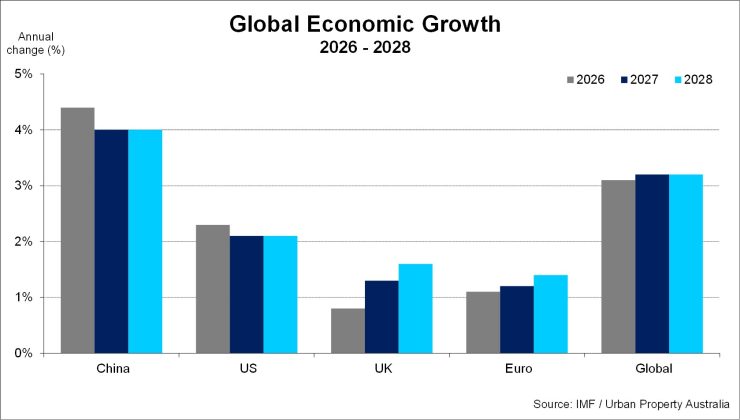
Global inflation has been largely steady through the trade tensions between China and the United States, however the outbreak of the Middle East conflict has led to an increased volatility with commodity prices projected to increase by 20% this year. Generally, fiscal policy in advanced economies, is expected to be neutral in 2026 and tighten from next year. Weakened consumer sentiment, easing labour markets and lower purchasing power in the context of high fuel and food prices are likely to maintain downward risks for the global economy. Beyond the immediate attention of the war, recent developments in artificial intelligence are likely to result in meaningful productivity gains which should boost global GDP over the medium term.
In the United States, the economy is projected to expand by 2.3% in 2026, with growth supported by fiscal policy despite the rise in trade barriers which continues to weigh on the level of activity. Longer term, economic growth of the United States is likely to be supported by the AI boom, which is boosting investment. Beyond this year, the US economy is forecast to ease to grow by 2.1% in 2027 and 2028.
In the Euro area, economic growth is expected to soften to 1.1% this year with growth of 1.2% forecast in 2027, lower than previously projected having been adversely impacted by the Middle East conflict maintaining the already elevated energy costs since Russia’s invasion of Ukraine, dragging on manufacturing productions. The impact of the planned increase in defence spending for most countries is expected to materialise only in later years, rather than the immediate future.
In the United Kingdom, the war and a slower pace of monetary easing mean that growth is projected to decline from 1.3% in 2025 to 0.8% this year, a downward revision on previous forecasts, as the impact of higher energy prices lingers. Consumer confidence is falling sharply due to the cost-of-living crisis and higher fuel prices with businesses reducing hiring intentions.
In contrast to other regions, economic growth in China for 2026 has been revised upwards, reflecting the lower US effective tariff rates on Chinese goods, despite the negative impact of the shock induced by the Middle East conflict. Albeit lower than recent years, China’s economy is projected to increase to 4.4% this year with growth of 4.0% forecast in 2027 and 2028 impacted by a slowdown in the housing sector and a declining labor force.
In India, its economy this year is projected to moderate with annual growth of 6.5% forecast, boosted by a decline of additional US tariffs on Indian goods from 50% to 10%, which outweigh the adverse impact of the Middle East conflict. Growth is projected to stay at 6.5% in 2027.
Copyright © 2026 by Urban Property Australia All rights reserved. No part of this publication may be reproduced in any form, by microfilm, xerography, electronically or otherwise, or incorporated into any information retrieval system, without the written permission of the copyright owner.