Q1 2026 – Melbourne Residential Market
April 30th 2026 | , Urban Property Australia
- Melbourne’s median house prices increased for a fifth consecutive quarter, rising to its highest level since mid-2022, up 7.7% over the past year;
- Victorian housing finance commitments now sit 28% above the 10-year average with $95 billion financed – its highest volume in three years, driven by strong demand from investors;
- While current construction levels of Victoria’s new dwellings have increased 4% over the year, they remain 19% lower than its 10-year average impacted by elevated construction and finance costs.
Residential Market Summary
Melbourne’s median house prices continue to improve, having increased for a fifth consecutive quarter, rising to its highest level since mid-2022. While current construction levels of Victoria’s new dwellings have increased 4% over the year, they remain 19% lower than its 10-year average. With vacancy remaining low, the weekly median rent for houses in metropolitan Melbourne sits just short of its all-time high while Melbourne units recorded stronger rental growth and sit at record high levels. Outside of Melbourne, both the median Victorian Regional house price and median Victorian Regional unit price have reached all-time highs as at March 2026.
Prices
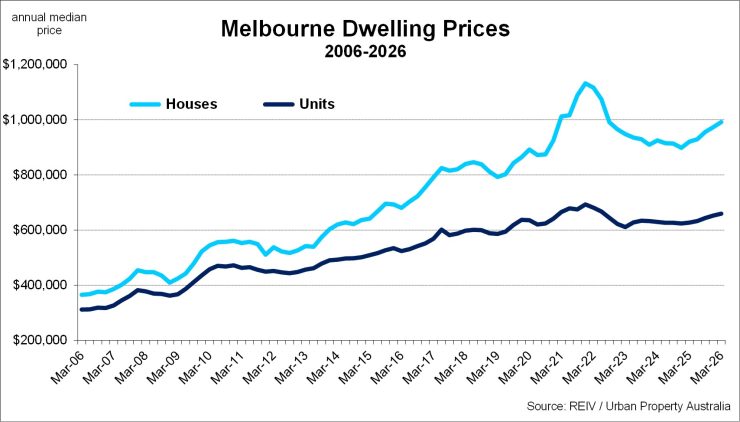
Melbourne’s median house prices continue to improve, having increased for a fifth consecutive quarter according to the REIV. As at March 2026, Melbourne’s median house price increased to $991,500 up 1.9% over the quarter and is now 7.7% higher than prices recorded 12 months ago according to the REIV. The median house price of Melbourne has now increased to its highest level since mid-2022. Melbourne median unit prices also increased over the quarter and year with Melbourne unit prices having increased over the 2026 March quarter by 1.1%, up to $659,500. Like the detached housing market, as at March 2026, the Melbourne median unit prices grew over the past 12 months up 5.2% with current levels at their highest levels since mid-2022. Despite the growth, median prices of both Melbourne houses and units however remain below their peak levels with median house prices 12% lower and median unit prices 5% below their peaks. Outside of Melbourne, the median Victorian Regional house price increased over the March 2026 quarter, increasing to $672,000, reaching an all-time high. The median Victorian Regional unit price also increased over the Match 2026 quarter, rising to $462,000, also a record high.
Supply
There are currently 60,200 dwellings under construction across Victoria according to the ABS. While current construction levels of Victoria’s new dwellings (houses and apartments) have increased 4% over the year, they remain 19% lower than its 10-year average. Impacted by elevated construction and finance costs, high-density apartment development remains constrained, albeit levels have picked up over the past 12 months. While the number of apartments currently under construction in Victoria has increased to 38,700, current levels remain 10% lower than its 10-year average. Similarly, within the detached housing market, current levels of new houses in development sit 9% lower than its decade average with 21,400 houses currently under construction. Looking forward, while supply levels are projected to remain below average, the number of dwellings commencing construction has lifted to its highest level since 2023. The constrained pipeline of housing stock is further evidenced by decreasing level of approved dwellings in Victoria with current levels 15% lower than the 10-year average. To encourage supply, the Victorian state government has recently announced two policies that aim to give developers an incentive to build. Firstly, stamp duty was reduced from October 2024 and be in place for 12 months and available for off-the-plan units, townhouses and apartments for properties at any price point, which has now been extended for a further 12 months to 20 October 2026. Secondly, to encourage more density around railway and tram lines, the government has identified 60 new activity centres where the planning process for multi-storey residential dwellings will be streamlined to fast-track development to potentially encourage more than 300,000 dwellings to be built by 2051.
Demand
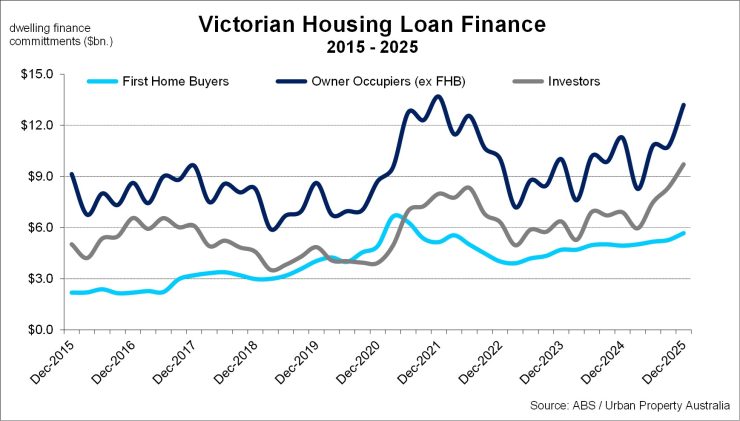
Total quarterly Victorian housing finance commitments continue to gather momentum having trended upwards since 2023 and now sit 28% above the 10-year average as at December 2025 with $95 billion financed – its highest volume in three years. Dwelling finance commitments have increased across all categories over the past 12 months. Non-first home buyer owner occupier finance levels have increased by 17% compared to the preceding year; with first home buyers also active with their levels 15% higher than last year. Investors now account for 34% of total housing finance commitments in Victoria, above the decade average share of 31%. Demand for new housing continues to outstrip supply with Victoria’s population increasing by 122,000 in the year to September 2025, largely due to overseas migration. While lower than all-time high levels, Victoria’s population continues to grow by the highest level of any Australian state, 16% higher than New South Wales’ annual population growth. Looking ahead, with strong rental growth and a shortage of housing, Urban Property Australia expects that first home owners will grow their share of housing loans encouraged by new government incentives.
Vacancy
As at March 2026, the vacancy rate for Melbourne residential property remained steady at 2.5% compared to its rate a year earlier but remains below the 10-year average of 2.9% according to the REIV. All precincts’ current vacancy rates now sit below their respective 10-year averages; with the exception of the Outer region. Over the past 12 months, only the overall Inner (0-10km) region recorded a decline in vacancy with both the Middle and Outer regions recording an increase in vacancy. The vacancy rate of the Inner (4-10km) region along with the Outer region both recorded the tightest rates at 1.8%. The Middle Melbourne region holds the highest vacancy rate at 2.8% and the overall Inner (0-10km) region sits at 2.6%. Looking ahead, Urban Property Australia projects that the vacancy rate for the metropolitan Melbourne area will remain low with supply levels remaining constrained while Victoria’s population is growing faster than in any other Australian state.
Rents
Metropolitan residential rents across the precincts increased (or remained steady) over the past year, reflecting the low vacancy environment, according to the REIV. Over the year to March 2026, the weekly median rent for houses in metropolitan Melbourne remained steady at $580 per week, just short of the all-time high of $590 per week achieved at the start of 2026. Across Melbourne, rents for houses located in the Middle region increased the most over the year, increasing by 6.7%, with rental growth of 2.8% recorded in the Inner region and rents in the Outer region remaining steady. Melbourne units recorded stronger rental growth with an annual rise of median rents increasing by 4.3% over the year with all precincts recording rental growth for units. Looking forward, Urban Property projects that residential rental rates will continue to increase; however, the pace of growth is anticipated to slow. This moderation reflects the effects of affordability constraints on renters’ capacity to accommodate the substantial rent increases experienced in recent years.
Regional
The median Victorian Regional house price increased over the March 2026 quarter, rising to $672,000 – an all-time high, surpassing the previous record set in December 2025 quarter. The median Victorian Regional unit price also rose over the quarter, increasing to $462,000, also a record high. Boosted by a low vacancy environment and an underlying shortage of new supply, residential rental levels in the Regional markets have remained resilient with the average weekly rental levels for both houses and units sitting at all-time highs as at March 2026. The vacancy rate for Regional Victoria remains very tight at 2.3%, below the metropolitan average of 2.5%.
Copyright © 2026 by Urban Property Australia All rights reserved. No part of this publication may be reproduced in any form, by microfilm, xerography, electronically or otherwise, or incorporated into any information retrieval system, without the written permission of the copyright owner.