Q1 2026 – Victorian Economic Overview
April 30th 2026 | , Urban Property Australia
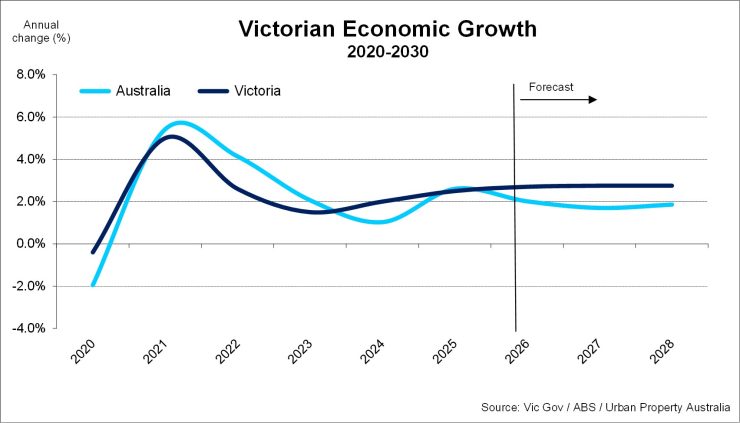
The Victorian economy grew by 2.7% over 2025 and is forecast to increase by 2.5% over the 12 months to June 2026. While employment levels continue to grow, the rate of growth has steadily slowed over the past three years. Over the 12 months to March 2026, total employment in Victoria increased by 26,000, the lowest annual level since 2021 and well below the annual employment growth of 71,500 recorded 12 months ago. Unsurprisingly, the softening labour market of Victoria has led to the State’s unemployment rate rising, with its current rate of 4.8% in March 2026, higher than the rate of 4.3% a year earlier. Looking ahead, Victorian employment is forecast to grow at a lower rate of 0.5% with the unemployment rate expected to rise through 2026, as growth in the workforce exceeds growth in employment.
Much of the State’s economic activity has been driven by dwelling investment in Victoria, having risen by 3.9% – its highest level in three years. The increase in residential construction has been supported by an easing of construction labour shortages. Looking forward, dwelling investment is forecast to increase, supported by a further easing in industry capacity constraints and an increase in demand for new housing. Slower growth in building costs, and an anticipated increase in the price of established dwellings, are expected to make it increasingly attractive to build a new dwelling relative to purchasing an existing home. This improvement in demand for new dwellings, alongside an elevated pipeline of work to be done, supports the outlook for stronger growth in dwelling investment over the next 12 months.
Although dwelling investment grew strongly, more broadly, state business investment grew modestly, following three years of strong growth. Investment was driven by spending on intellectual property, which includes digitisation and cyber security. Engineering construction also increased, including projects related to the energy transition.
With consumer confidence weakening, household consumption growth remains modest as ongoing cost-of-living pressures outgrew household disposable income which has not keep pace with the growth in consumer prices which have been underpinned by the elevated inflation environment. Over the past 12 months, household consumption recorded a modest rise in total spending, with consumers focusing their spending on essential items.
Goods exports recorded solid growth last year, driven mainly by robust global demand for food products, especially meat. Beef exports performed particularly well as Victorian producers increased supply in response to drought conditions and high global demand.
Public demand also contributed to growth in Victoria’s state final demand, contributed to in part by increased Commonwealth spending across various social benefits programs and infrastructure projects.
Latest data reveals that Victoria’s population grew by 1.7% over the year to September 2025, continuing the moderation in growth having previously grown strongly in 2022 and 2023, but remains a little above the long-term average growth rate of 1.6%. Over the past year, the easing in population growth has been driven by a softening in net overseas migration. While Victoria’s population continues to expand more than its 10-year average, increasing by 122,000 people, current levels have fallen from growth of 187,900 people two years ago.
Copyright © 2026 by Urban Property Australia All rights reserved. No part of this publication may be reproduced in any form, by microfilm, xerography, electronically or otherwise, or incorporated into any information retrieval system, without the written permission of the copyright owner.