Q3 2025 – Australian Economic Overview
April 5th 2026 | , Urban Property Australia
After years of subdued growth, Australia’s economy is gathering momentum, illustrated by Australia’s economy growing by 0.6% in the June 2025 quarter, up from 0.3% in the March quarter, when activity was heavily impacted by weather events. On an annual basis, Australia’s economy increased by 1.8%, the highest annual growth rate since the September quarter 2023, and exceeding projections of 1.6%. Nevertheless, through the year, GDP per capita has only risen by 0.2% once population growth is considered.
While many households remain cautious and still boosting savings, generally consumer spending is broadening. During the June quarter, household spending rose by 0.9%, following a 0.4% rise last quarter. This was the fastest pace of growth since the December quarter 2022. It appears that improved sentiment in response to lower interest rates and the Stage 3 tax cuts has finally translated into more bullish consumption activity. With interest rates now at a more accommodative level, inflation remaining stable and real wage growth continuing, consumption growth is likely to continue over the upcoming quarters. Looking ahead, one more interest rate cut is expected this year; followed by one more rate cut in the first half of 2026, bringing the cash rate to 3.1%.
Lower interest rates are supporting private investment, particularly in housing with momentum in house price growth continuing to build. With advertised supply levels around 20% lower than average for this time of year, and auction clearance rates hitting their highest levels in a year, this upward trajectory for prices is likely to continue. This may be further boosted by increased demand from first home buyers, as support measures announced in the Federal Budget take effect.
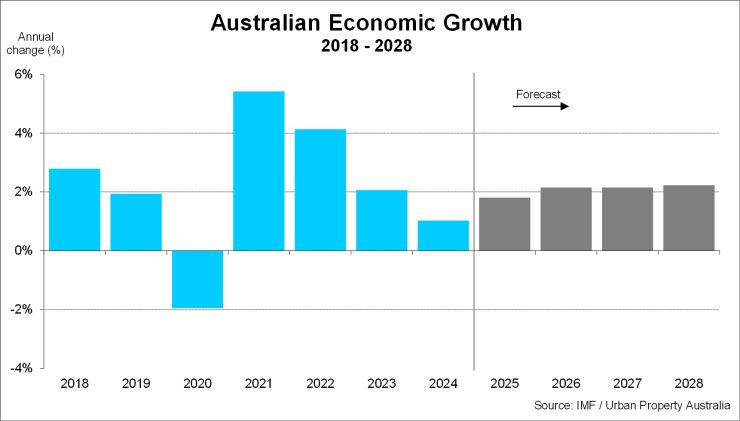
However, non-housing investment remains subdued in recent quarters. Overall, on an annual basis, total investment grew by 1.0% in the year to June 2025, the lowest rate since the December quarter 2020. Across the states and territories, the largest rises were seen in Victoria followed by New South Wales with the largest falls seen in Queensland followed South Australia. Moving forward, private investment is projected to increase with businesses have revised up their expected investment by 12.0% increase compared to the preceding year.
In contrast, government spending fell by 3.9% in the June quarter, following a 2.4% fall in the March quarter, to be down 0.8% through the year. Overall, public investment has fallen 6.8% compared to the peak seen late last year. The decline was primarily driven by reduced investment from both national and state governments across road, rail and health infrastructure, as several major projects neared completion across various jurisdictions. Additionally, national defence investment contributed to the fall, although it remains at elevated levels.
Australia’s labour market remains resilient. After holding steady at 4.1% for the first five months of 2025, the unemployment rate rose to 4.3% in June, before settling at 4.2% in both July and August. The unemployment rate is forecast to increase to peak at 4.3% through 2025 after which is expected to stabilise in early 2026 as economic growth picks up further.
Copyright © 2025 by Urban Property Australia All rights reserved. No part of this publication may be reproduced in any form, by microfilm, xerography, electronically or otherwise, or incorporated into any information retrieval system, without the written permission of the copyright owner.