Q3 2025 – Melbourne Retail Market
April 5th 2026 | , Urban Property Australia
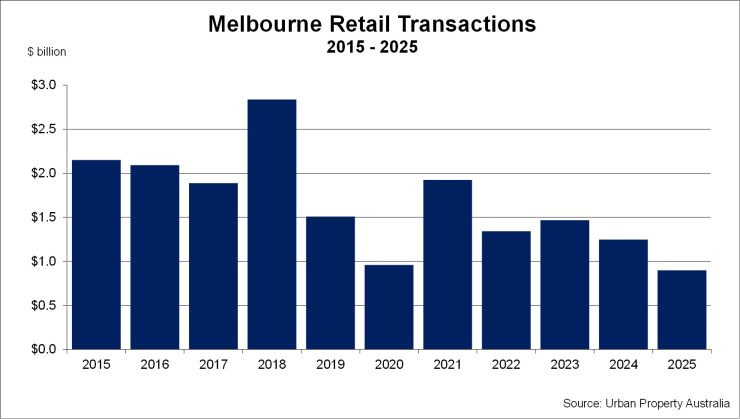
- More than $900 million transacted in the Melbourne retail property market in 2025 with investors becoming increasingly confident in the sector given the resilience of consumer sales;
- Victorian household spending continues to gather momentum recording its highest annual growth rate since November 2023 with both discretionary and non-discretionary spending increasing;
- Total vacancy of Melbourne’s prime retail strips increased over the past 12 months with 11% of all shops vacant with significant variances across individual precincts.
Retail Market Summary
Boosted by ongoing population growth and improving consumer confidence, Victorian household spending continues to gather momentum recording its highest annual growth rate since 2023 with both discretionary and non-discretionary spending increasing. Retailer demand has been particularly strong in sectors with essential goods, such as supermarket-anchored neighbourhood centres and household goods in large format retail, the latter supported by ongoing housing activity. Limited new supply is intensifying leasing competition, particularly in prime locations. Coupled with the ongoing strength of consumer spending, investment activity has been supported by the cash rate cuts leading to more than $900 million transacted in the Melbourne retail property market.
Sales Volume / Yields
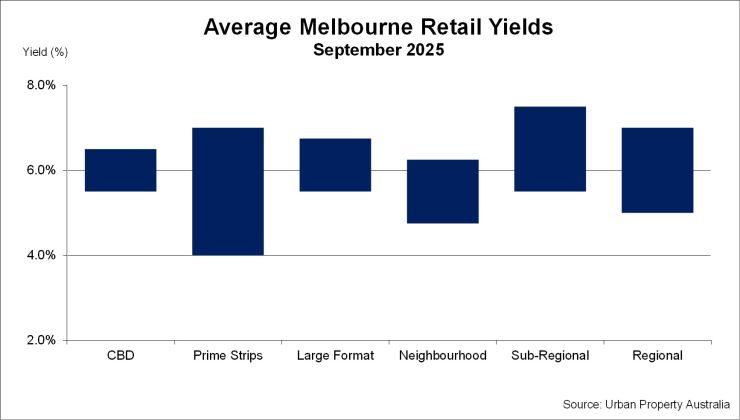
Urban Property Australia research recorded more than $900 million transacted in the Melbourne retail property market in 2025 to date with investors becoming increasingly confident in the sector given the resilience of consumer sales. This year’s volume of retail property sales has been boosted by the 50% share of the Northland shopping centre for $385 million, Victoria’s biggest retail transaction in seven years. In addition to the half-share of the Northland sale, there have been several transactions exceeding $50 million which have led to the increased volume of Melbourne retail asset sales. Coupled with the ongoing strength of consumer spending, investment activity has been supported by the 75 basis points in cash rate cuts during 2025, with further easing expected in coming months. Both private investors and institutional investors have been active coupled with a relatively constrained pipeline of investment opportunities has maintained pressure on retail asset yields over the past year according to Urban Property Australia research. Looking ahead, with further rate cuts and increasing investor confidence, yields are likely to compress.
Demand
Boosted by ongoing population growth and improving consumer confidence, Victorian household spending continues to gather momentum. Over the year to August 2025, Victorian household spending increased by 4.3%, its highest annual growth rate since November 2023. Despite global uncertainties, both discretionary and non-discretionary Victorian household spending is increasing, albeit discretionary spending still modestly recovering with annual growth of 3.5% compared to non-discretionary annual growth of 5.6%. While sales of alcohol and tobacco have contracted, clothing retail sales increased by 2.5% over the year with growth also recorded in food (+6.7%), household goods (+2.7%) and cafes and restaurants (+5.7%).
Retailer demand has been particularly strong in sectors with essential goods, such as supermarket-anchored neighbourhood centres and household goods in large format retail, the latter supported by ongoing housing activity. Limited new supply is intensifying leasing competition, particularly in prime locations with the CBD market is also experiencing a demand uplift as foot traffic recovers, driven by the return of employees to workplaces.
It is estimated that Australians spent $65 billion on online retail over the 12 months to August 2025. Growth was mixed in the month, with a large drop in department store sales and a fall in takeaway food sales almost offset by growth in all other categories. Large sales category, homewares and appliances, returned to growth in August after contracting heavily in July. Looking through the recent monthly volatility, this category is beginning to trend higher in growth terms, consistent with a pick-up in house prices and housing turnover.
Rents generally have recorded modest growth across Victoria’s retail shopping centre assets over the year to September 2025 with large format centres and neighbourhood shopping centres outperforming other Victorian retail assets supported by limited new supply. Melbourne CBD retail rents have now stabilised over the past year, having declined in recent years, which may indicate a modest recovery. Rents are expected to gain momentum through the year as discretionary spending continues to recover.
Retail Strips
Melbourne’s prime strips performance varies significantly with levels of vacancy and neighbourhood amenities. Total vacancy of Melbourne’s prime retail strips increased over the past 12 months with 11% of all shops vacant. The vacancy levels of Bridge Road, Richmond is the highest at 19% with elevated vacancy rates at Chapel Street, South Yarra (10%) and Lygon Street, Carlton (9%). Elsewhere, the vacancy rate for Church Street, Brighton and Centre Road, Bentleigh remain very low with both strips recording vacancy rates lower than 3%.
The food and beverage sector continued to grow its presence across the strips, growing in the majority of the precincts however a number of fashion retailers have vacated the prominent strips, impacted by store rationalisation and the growing influence of e-commerce.
Several strips are benefiting from nearby developments, increasing the local population which have increased foot traffic to the precincts leading to increased tenant demand. The Victorian government’s activity centre program would likely further boost shopping strip foot traffic with the state government, encouraging more than 300,000 homes to be built close to public transport, jobs and services.
With many strips having been re-discovered by locals now working from home, some retailers have successfully adjusted to the changing consumer trends. With the workforce continuing to spend time working remotely, Urban Property Australia has witnessed increased demand from recreational tenants such as fitness and health businesses for locations in Melbourne’s prime strips as the local residents continue to change their spending patterns.
The elevated vacancy levels and rationalisation of some retailers has resulted in rental levels easing with Urban Property Australia seeing landlords also offering flexible lease terms and incentives to attract new occupiers.
Copyright © 2025 by Urban Property Australia All rights reserved. No part of this publication may be reproduced in any form, by microfilm, xerography, electronically or otherwise, or incorporated into any information retrieval system, without the written permission of the copyright owner.